Caer Ibormeith
The Swan Maiden of Celtic Myth and Stronghold of the Heart
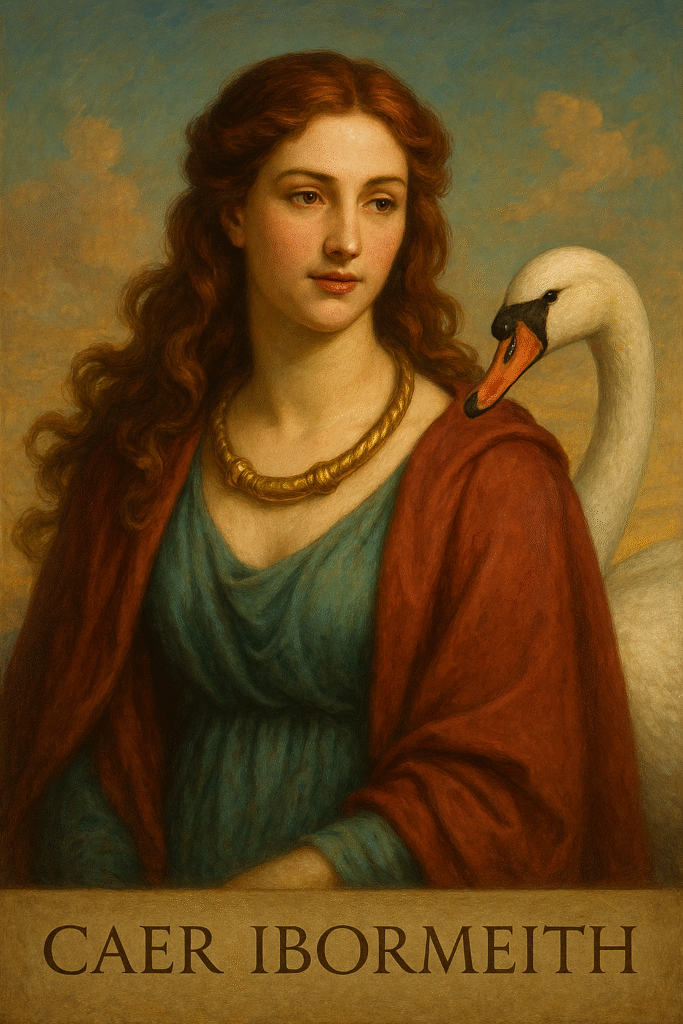
In the rich tapestry of Celtic mythology, few figures are as enchanting and mysterious as Caer Ibormeith. Known as a swan maiden, a dream weaver, and a symbol of transformation, Caer’s story is deeply intertwined with themes of love, identity, and the power of listening to the soul’s quiet voice.
Born to Ethal Anbuail, one of the mystical Tuatha de Danann, Caer was part of a lineage that, over centuries, evolved in folklore from ancient deities into fae royalty and legendary heroes who withdrew into the magical earth mounds known as sidhes. She and her father resided in Sidhe Uamuin, nestled in Connacht.
Caer (pronounced “Keer”) was celebrated in poetry under names like “Shapely Yew Berry” and “Yew Berry.” She possessed the extraordinary ability to shift forms—spending one year as a radiant woman and the next as a graceful swan.
Each year, on Samhain—the threshold between the physical and spiritual realms— She would undergo her transformation, joined by 150 swans. In Celtic lore, swans are deeply symbolic, representing love, purity, the soul, and music. When tied to a goddess, they are distinguished by golden or silver chains around their necks and are seen as guides to the Otherworld, especially during Samhain.
Caer was a sovereign spirit, choosing her own path and partner.
💘 The Love Story: Caer and Aengus Óg
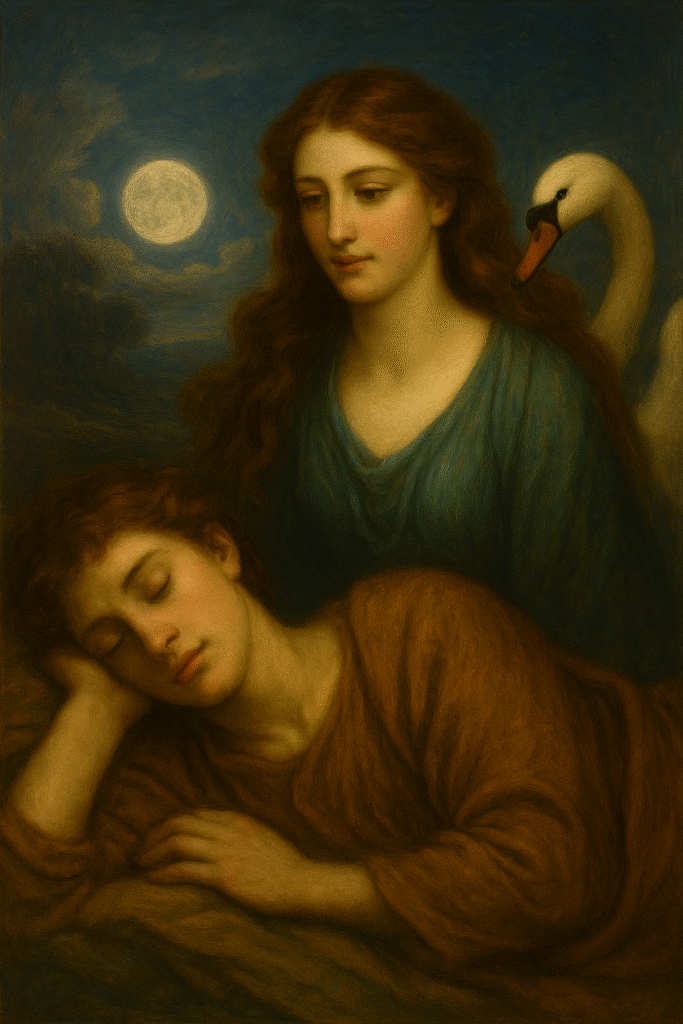
Caer Ibormeith is best known for her mythic romance with Aengus Óg, the Irish god of love, youth, and poetic inspiration.
She appeared in the dreams of Aengus Óg, son of the river goddess Bóann and the great Dagdha, leader of the Tuatha de Danann. Aengus, god of love, youth, and poetic inspiration, was enchanted by her nightly visits. Though he never spoke of it, her presence in his dreams left him lovesick and longing.
For a year, she came to him in sleep, playing haunting melodies on her timpan. Aengus grew ill, consumed by his yearning to remain in the dreamworld beside her. A healer was summoned and quickly understood the nature of his affliction. With the help of Bóann, a search began—but yielded no results. Dagdha then enlisted Bodb, king of the Munster sidhe, who spent another year seeking Caer.
Eventually, Queen Medb and King Aillil of Connacht joined the quest, as Caer’s sidhe lay within their domain. They found Ethal Anbuail and demanded Caer’s hand for Aengus. Ethal refused, explaining that Caer’s will was her own and her magic far surpassed his. He revealed her dual nature—woman and swan—and the ritual of transformation on Samhain.
Ethal offered one chance: Aengus must go to Loch Bél Dracon on Samhain, identify Caer among the swans, and call to her. Only if she chose to respond would she be his.
Aengus arrived at the lake and saw 150 swans, each adorned with silver chains. Despairing, he searched until one swan, bearing both silver and gold, glided toward him, shining brighter than the rest. He called out, and Caer answered—asking only that she be allowed to return to the water. Aengus agreed and transformed into a swan himself. Together, they circled the lake three times before soaring to Newgrange, singing a song so beautiful it cast a magical sleep over the land for three days and nights.
They returned to human form and lived in harmony and love. Legend says that on Samhain Eve, the song of their union can still be heard by those attuned to the unseen.
Their story is a metaphor for true connection—one that transcends appearances, ego, and even species. It’s about active listening, not just with ears, but with the heart.
🏰 The Name “Caer”: A Stronghold of Meaning
The name Caer in Welsh and Old Celtic means fortress or stronghold. It’s a word that appears in the names of cities like:
- Caer-Edin → Edinburgh
- Caer-Dyf → Cardiff
These cities, once ancient hillforts, carry the legacy of protection, resilience, and rootedness—qualities that Caer Ibormeith herself embodies. Though she transforms and flows like water, her essence is strong, grounded, and enduring.
In this way, Caer is not just a name—it’s a symbol of inner strength, the kind that holds firm even when the world shifts around you.
🦢 What Caer Represents in Celtic Mythology
Caer Ibormeith is more than a love interest. She represents:
- Transformation: Her dual nature as swan and woman reflects the cycles of life, identity, and emotional growth.
- Mystery and Feminine Power: She chooses her own path, even when pursued by gods.
- Harmony with Nature: Her connection to swans and water speaks to the Celtic reverence for the natural world.
- Listening and Intuition: Her story teaches that love and truth are found not through force, but through quiet understanding.
🌕 Final Thoughts
This tale reminds us that love is not possession—it’s recognition. That strength is not rigidity—it’s the ability to transform while staying true to oneself. And that sometimes, the most powerful thing we can do is listen—to dreams, to others, and to the quiet voice within.
So whether you’re navigating relationships, building your own “stronghold,” or simply seeking beauty in myth, Caer’s story offers timeless wisdom wrapped in feathers and moonlight.
Would you like to ilicit the power of CAER?



Maria da Silva
Maria da Silva (PhD, DHP Acc Hyp) is a Cognitive Behavioural Hypnotherapist and a Trauma/Attachment Informed Coach, an expert in helping people understand and overcome their past conditioning and engage in meaningful and peaceful relationships through Nonviolent Communication.


